PPF vs. a Vinyl Wrap: They Get Mixed Up Constantly, Here Is the Real Difference
One is about the rocks and debris on Texas highways. The other is about changing how your car looks. Both live on the same car all the time.
September 8, 2026 · 4 min read
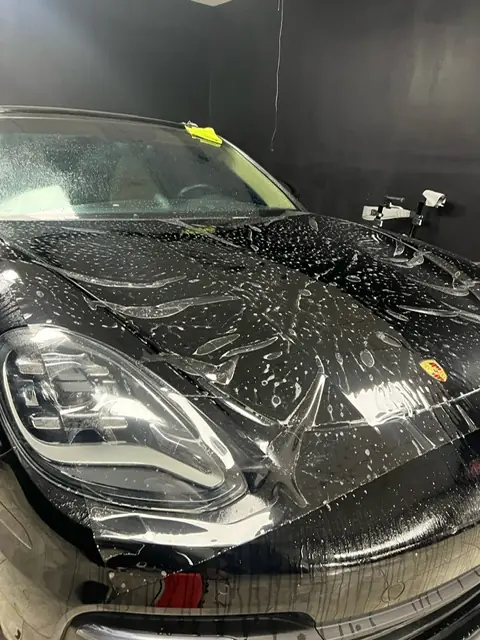
We get some version of this question almost daily: is paint protection film the same thing as a wrap? They are cousins, not the same job, and mixing them up leads people to ask for the wrong service or expect the wrong result. Once you know what each one is actually built to do, the confusion clears up fast.
PPF is armor. A wrap is a new look.
Paint protection film is a clear, tough urethane film applied to the parts of your car that take the most abuse from the road. Its whole job is to absorb impacts from gravel, road debris, and small rock chips before they ever reach your factory paint. Done right, it is close to invisible. Nobody at a stoplight is going to notice your PPF. They will notice if your front bumper stays chip free after two years of San Antonio highway driving while everyone else's does not.
A vinyl wrap is a colored or finished film that changes how the car looks. Gloss, matte, satin, a color shifting finish, camo, a fully custom printed design, all of that is wrap territory. Where PPF tries to disappear, a wrap is meant to be seen.
Coverage: how much of the car gets covered
- Full front end PPF: the front bumper, hood, fenders, mirrors, and the lower rocker panels, which is where the vast majority of rock chip damage actually happens on the highway.
- Full body PPF: the entire exterior of the car, used most often on higher end vehicles where the owner wants complete protection with zero visible seams over time.
- Full color change wrap: every exterior panel, changing the entire look of the car.
- Partial or accent wraps: specific panels, like a roof, hood stripe, or mirror caps, layered on top of the factory paint or an existing wrap for a two tone look.
You are not choosing one over the other in a lot of cases. Plenty of the cars we build here get both. A customer wants a full color change wrap on a truck they drive on I-10 every day, so we will also recommend PPF over the front end so the new finish is not eating rock chips from day one. We have done this exact combination on G-Wagons and Range Rovers that came through the shop, full frontal PPF paired with the color work and accent wraps the owner wanted.
Can you tint the windshield too?
This comes up in the same conversation a lot, so worth mentioning here: yes, the front windshield can be ceramic tinted, not just the side and rear glass. A lot of people assume the windshield is off limits. We do windshield ceramic tint regularly, and it makes a real difference for anyone who drives with the sun coming straight through the glass on a Texas afternoon.
How to think about which one you need
If your goal is protecting the investment you already made in your car's paint, especially on a newer vehicle or one that racks up highway miles between San Antonio and the surrounding towns, PPF is the tool for that job. If your goal is a different look entirely, a wrap is the tool. If you want both a fresh look and protection for it, that is a full color change wrap with PPF layered over the high impact zones, which is one of the more common combinations we build.
We have installed PPF on Porsches, Escalades, G63s, and plenty of daily drivers that just needed the front end protected, and we have wrapped just as many cars in colors that never came from the factory. Both jobs get the same attention to prep and edge work, because a sloppy edge on either one is where problems start down the road.
What a good PPF install actually looks like
PPF is only as good as the hands that put it on. The film has to be cut precisely for the panel it is going on, whether that is a pre-cut pattern for the exact make and model or a hand-trimmed piece for a custom section. The edges have to be wrapped or tucked cleanly so there is nothing for a car wash brush or a fingernail to catch on. Skip that step and the film starts lifting at the same edges a rushed wrap would, and now you have paid for protection that is not actually protecting anything.
We treat PPF the same way we treat a full color change wrap: proper surface prep before anything gets applied, careful edge work on every seam, and a final check for trapped air or dust under the film before the car leaves the shop. It is slower than rushing the job, and it is the only way the film actually does what it is there to do.
If you are not sure which service fits what you are picturing for your car, that is exactly the kind of question to bring to the shop rather than guess at. Stop by 529 State Highway 46 E in Boerne, Monday through Friday between 10 and 6, or call 210-999-9727 and Armin or the team can walk you through it.
Texas Custom Wraps — (210) 999-9727
Call (210) 999-9727More articles
Wrap or Respray? What a Color Change on Your Car Actually Means
The two ways to change your car's color are not the same job, not the same result, and not the same commitment.
Ceramic Window Tint and Texas Heat: Why It Is About More Than Looking Darker
In a Texas summer, the film on your glass is doing real work long before you notice how dark it looks.